
woa <- readr::read_csv(
  here::here("data", "SAMOS", "processed", "woa18_sa_core_1deg_monthly.csv"),
  show_col_types = FALSE
)

# convenience slices used repeatedly below
woa_feb_surf <- woa %>%
  filter(month == 2, depth_m == 0)

woa_temp_depths <- woa %>%
filter(variable == "temperature", depth_m %in% c(0, 50, 100, 200, 500))Intro R Task C

10–12. Graphics With ggplot2, Faceting Figures, and Brewing Colours (WOA edition)
In this task set you will generate several figures using a tidy extract of the World Ocean Atlas 2018 (WOA18) climatology.
NoteDataset significance (WOA18)
WOA18 provides globally gridded climatological means for core ocean variables:
- Temperature and salinity describe the physical state of the ocean.
- Dissolved oxygen reflects ventilation and biogeochemical conditions.
- Nutrients (nitrate, phosphate, silicate) constrain biological productivity.
In this task we use a regional extract (Southern Africa + adjacent ocean) at a 1° grid and a small set of depths.
TipData dictionary
See: data/SAMOS/processed/woa18_sa_core_1deg_monthly_DICTIONARY.md
Question 1
Create a scatterplot of salinity against temperature (a classic T–S view) for the surface (0 m) climatology in February. Label axes with units. (/10)
TipAnswer
woa_feb_surf %>%
  filter(variable %in% c("temperature", "salinity")) %>%
  select(lon, lat, variable, value) %>%
  pivot_wider(names_from = variable, values_from = value) %>%
  ggplot(aes(x = salinity, y = temperature)) +
  geom_point(alpha = 0.35, size = 0.8) +
  labs(x = "Salinity (PSU)", y = "Temperature (°C)") +
  theme_minimal()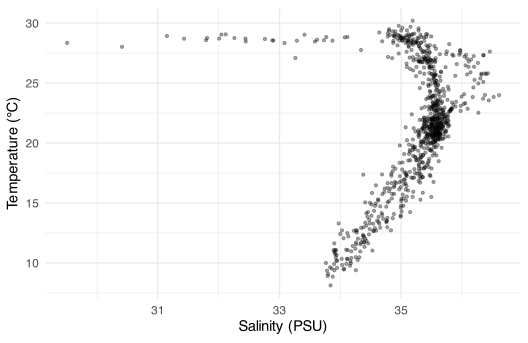
Interpretation (example): the scatter is not a time series; it is the spatial range of surface conditions across the region. Expect warmer, saltier points toward the subtropics and cooler/fresher points toward higher latitudes and near river-influenced shelves.
Question 2
Create three histograms of surface nitrate (February), one for each depth bin below (treat depth as a filter, not a facet):
- 0 m
- 50 m
- 200 m
Save each histogram as an R object. Then combine them into one figure using ggarrange() (1 column × 3 rows). (/25)
TipAnswer
n0 <- woa %>%
  filter(month == 2, variable == "nitrate", depth_m == 0) %>%
  ggplot(aes(x = value)) +
  geom_histogram(bins = 40, fill = "grey70", colour = "white") +
  labs(title = "0 m", x = "Nitrate (µmol/kg)", y = "Count") +
  theme_minimal()

n50 <- woa %>%
  filter(month == 2, variable == "nitrate", depth_m == 50) %>%
  ggplot(aes(x = value)) +
  geom_histogram(bins = 40, fill = "grey70", colour = "white") +
  labs(title = "50 m", x = "Nitrate (µmol/kg)", y = "Count") +
  theme_minimal()

n200 <- woa %>%
  filter(month == 2, variable == "nitrate", depth_m == 200) %>%
  ggplot(aes(x = value)) +
  geom_histogram(bins = 40, fill = "grey70", colour = "white") +
  labs(title = "200 m", x = "Nitrate (µmol/kg)", y = "Count") +
  theme_minimal()

ggarrange(n0, n50, n200, ncol = 1, nrow = 3)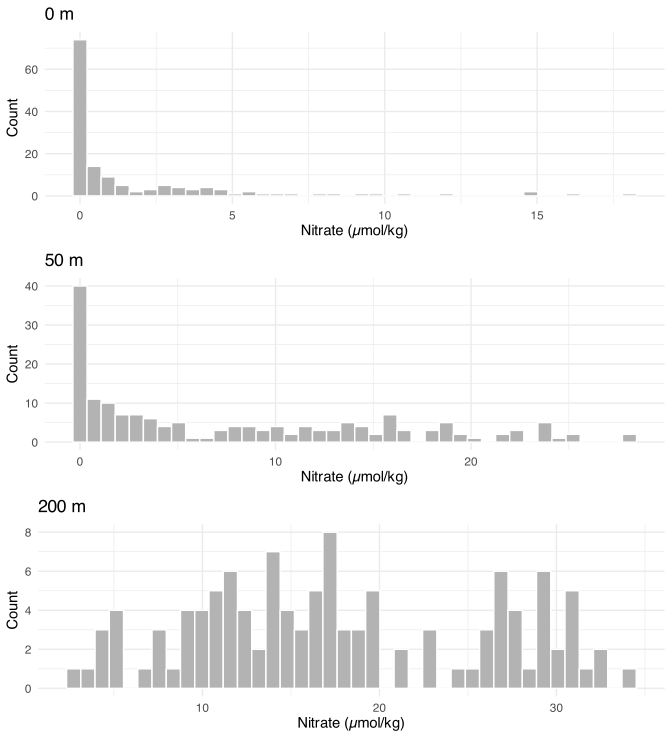
Interpretation (example): nitrate is typically low at the surface (consumed by biology) and increases with depth as remineralised nutrients accumulate.
Question 3
Create a scatter plot of temperature against latitude for February, and use facet_wrap() to create separate panels for each depth (0, 50, 100, 200, 500 m). Add a smooth line to each panel. (/10)
TipAnswer
woa %>%
  filter(month == 2, variable == "temperature", depth_m %in% c(0, 50, 100, 200, 500)) %>%
  ggplot(aes(x = lat, y = value)) +
  geom_point(alpha = 0.15, size = 0.6) +
  geom_smooth(se = FALSE, method = "loess") +
  facet_wrap(~ depth_m, ncol = 3) +
  labs(x = "Latitude (°N)", y = "Temperature (°C)") +
  theme_minimal()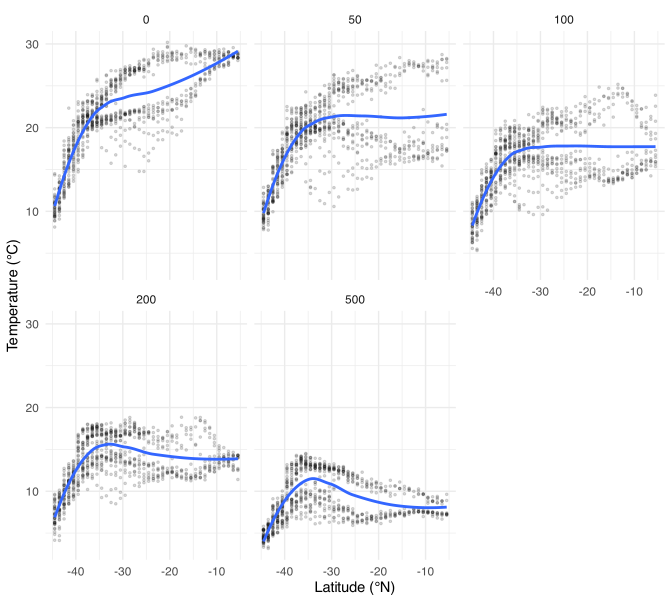
Interpretation (example): the surface panel usually shows the strongest meridional gradient; deeper panels show reduced seasonal/latitudinal contrast.
Question 4
Create a scatter plot of dissolved oxygen against temperature at the surface (0 m), using all months (1–12). Use facet_wrap() to create one panel per month, and map a continuous colour scale to oxygen using a custom gradient (not the default). (/10)
TipAnswer
woa %>%
  filter(depth_m == 0, month %in% 1:12, variable %in% c("temperature", "dissolved_oxygen")) %>%
  select(lon, lat, month, variable, value) %>%
  pivot_wider(names_from = variable, values_from = value) %>%
  ggplot(aes(x = temperature, y = dissolved_oxygen, colour = dissolved_oxygen)) +
  geom_point(alpha = 0.5, size = 0.7) +
  facet_wrap(~ month, ncol = 4) +
  scale_colour_gradientn(
    colours = c("#2c7bb6", "#abd9e9", "#ffffbf", "#fdae61", "#d7191c"),
    name = "Oxygen (µmol/kg)"
  ) +
  labs(x = "Temperature (°C)", y = "Dissolved oxygen (µmol/kg)") +
  theme_minimal()
Interpretation (example): oxygen tends to be higher in cooler waters, but the relationship can vary by month and location because circulation and biology matter.
Question 5
Using the figure created in Question 4, also show the effect of depth by adding shapes for depth (0 vs 50 m). Fit a single best‑fit straight line (ignoring depth) to each monthly panel. Explain what the line represents. (/10)
TipAnswer
woa %>%
  filter(depth_m %in% c(0, 50), month %in% 1:12, variable %in% c("temperature", "dissolved_oxygen")) %>%
  select(lon, lat, month, depth_m, variable, value) %>%
  pivot_wider(names_from = variable, values_from = value) %>%
  ggplot(aes(x = temperature, y = dissolved_oxygen)) +
  geom_point(aes(colour = dissolved_oxygen, shape = factor(depth_m)), alpha = 0.55, size = 0.8) +
  geom_smooth(method = "lm", se = TRUE, colour = "black") +
  facet_wrap(~ month, ncol = 4) +
  scale_colour_viridis_c(name = "Oxygen (µmol/kg)") +
  labs(
    x = "Temperature (°C)",
    y = "Dissolved oxygen (µmol/kg)",
    shape = "Depth (m)"
  ) +
  theme_minimal()
Interpretation (example): the line is a within-panel linear summary of the oxygen–temperature association across all grid cells shown in that month. It is not causal, and it ignores spatial structure and depth effects.
Question 6
What are the benefits of using faceting in data visualisation? (/3)
TipAnswer
- Faceting lets you compare the same relationship across groups (months, depths, variables) using a consistent visual grammar.
- It reduces overplotting and legend complexity by separating groups into panels.
- It supports pattern recognition (seasonal structure, depth structure) without changing the underlying plotting code.
Question 7
Create a scatter plot of phosphate against nitrate at 200 m for the annual climatology (month == 0), coloured by silicate (continuous palette). (/10)
TipAnswer
woa %>%
  filter(depth_m == 200, month == 0, variable %in% c("nitrate", "phosphate", "silicate")) %>%
  select(lon, lat, variable, value) %>%
  pivot_wider(names_from = variable, values_from = value) %>%
  ggplot(aes(x = nitrate, y = phosphate)) +
  geom_point(aes(colour = silicate), alpha = 0.6, size = 0.8) +
  scale_colour_viridis_c(name = "Silicate (µmol/kg)") +
  labs(x = "Nitrate (µmol/kg)", y = "Phosphate (µmol/kg)") +
  theme_minimal()
Interpretation (example): nutrients often covary because they are regenerated together at depth, but the ratios can change with region and water mass history.
Question 8
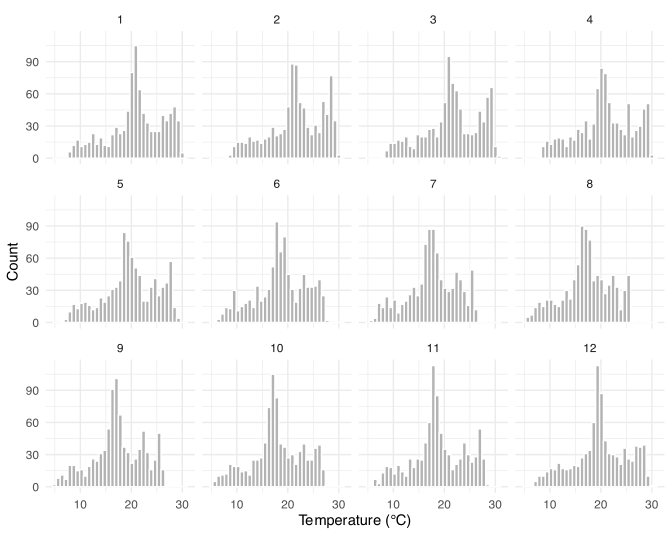
Create histograms of temperature for each month (surface, 0 m) using facet_wrap(). (/6)
TipAnswer
Question 9
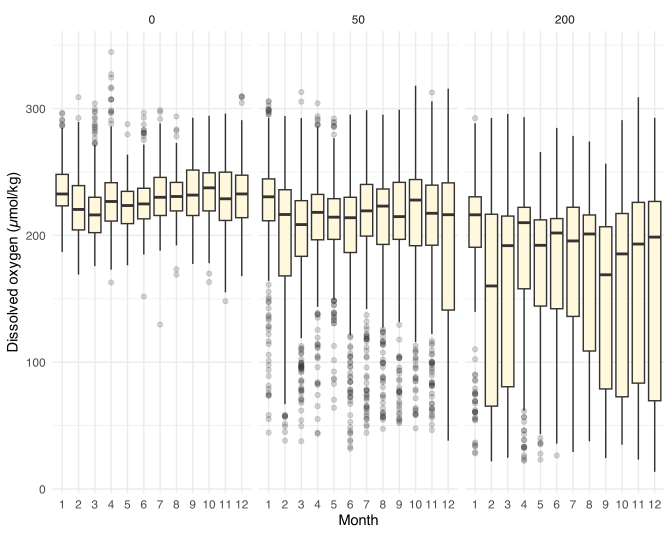
Create boxplots of dissolved oxygen by month and facet by depth (0, 50, 200 m). (/8)
TipAnswer
Question 10
Calculate the mean ± SD of temperature at each depth (0, 50, 100, 200, 500 m) for February, then plot the means with error bars. (/10)
TipAnswer
summary_temp <- woa %>%
  filter(month == 2, variable == "temperature", depth_m %in% c(0, 50, 100, 200, 500)) %>%
  group_by(depth_m) %>%
  summarise(
    mean_temp = mean(value, na.rm = TRUE),
    sd_temp   = sd(value, na.rm = TRUE),
    .groups = "drop"
  )

summary_temp %>%
  ggplot(aes(x = factor(depth_m), y = mean_temp, group = 1)) +
  geom_point(size = 2) +
  geom_line() +
  geom_errorbar(aes(ymin = mean_temp - sd_temp, ymax = mean_temp + sd_temp), width = 0.15) +
  labs(x = "Depth (m)", y = "Mean temperature (°C)") +
  theme_minimal()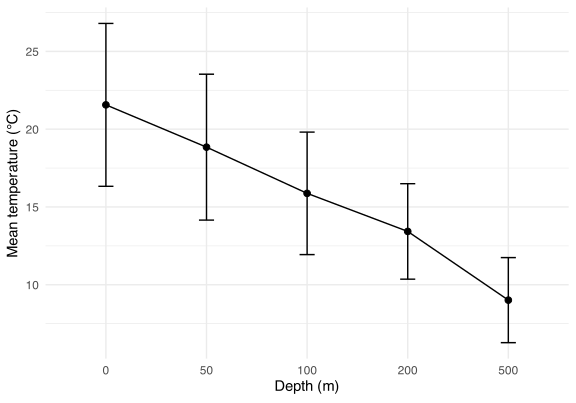
Interpretation (example): mean temperature declines with depth; SD reflects spatial variability across the study region at each depth.
Question 11
Create a violin plot of nitrate by depth (0, 50, 100, 200, 500 m), filled by month group: define season as JFM (1–3), AMJ (4–6), JAS (7–9), OND (10–12). (/8)
TipAnswer
woa %>%
  filter(month %in% 1:12, variable == "nitrate", depth_m %in% c(0, 50, 100, 200, 500)) %>%
  mutate(
    season = case_when(
      month %in% 1:3   ~ "JFM",
      month %in% 4:6   ~ "AMJ",
      month %in% 7:9   ~ "JAS",
      month %in% 10:12 ~ "OND"
    ),
    season = factor(season, levels = c("JFM", "AMJ", "JAS", "OND"))
  ) %>%
  ggplot(aes(x = factor(depth_m), y = value, fill = season)) +
  geom_violin(trim = TRUE, alpha = 0.8) +
  labs(x = "Depth (m)", y = "Nitrate (µmol/kg)", fill = "Season") +
  theme_minimal() +
  theme(legend.position = "bottom")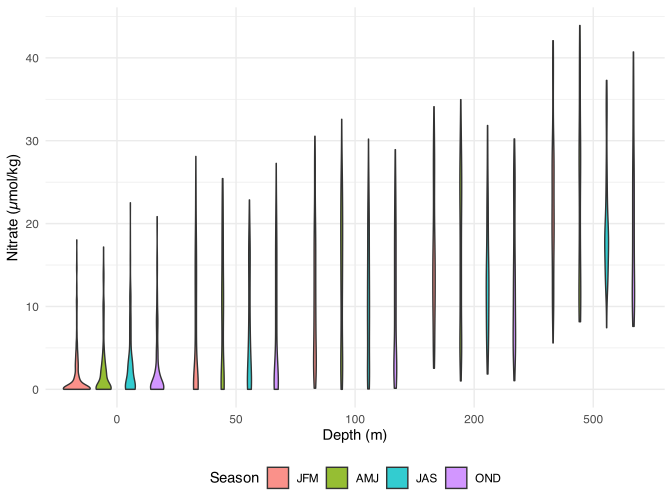
Question 12
Create a small summary table showing the number of observations for each combination of variable and depth_m (all months combined). (/6)
TipAnswer
R> # A tibble: 36 × 3
R>    variable         depth_m     n
R>    <chr>              <dbl> <int>
R>  1 dissolved_oxygen       0  3868
R>  2 dissolved_oxygen      50  3868
R>  3 dissolved_oxygen     100  3868
R>  4 dissolved_oxygen     200  3868
R>  5 dissolved_oxygen     500  3868
R>  6 dissolved_oxygen    1000  3868
R>  7 nitrate                0  1806
R>  8 nitrate               50  1806
R>  9 nitrate              100  1806
R> 10 nitrate              200  1806
R> # ℹ 26 more rows
Question 13
Briefly describe two patterns you observe in any of the figures above. (/4)
TipAnswer
Example patterns:
- Temperature decreases with depth, and the surface layer shows the strongest latitudinal/seasonal structure.
- Nutrients generally increase with depth (and are typically lowest at the surface), reflecting biological uptake near the surface and regeneration at depth.
Question 14
Please start with this figure and improve and expand on the analysis as shown below the figure:
NoteAbout the dataset used in this chapter (World Ocean Atlas 2018)
In this chapter we use a small, tidy extract of World Ocean Atlas 2018 (WOA18) climatologies for the broader Southern Africa region.
Why WOA matters in ocean science:
- Temperature and salinity are the fundamental state variables of seawater, and together shape density and stratification.
- Dissolved oxygen is a key indicator of ventilation, productivity, and habitat suitability.
- Nutrients (nitrate, phosphate, silicate) constrain primary production and structure ecosystems.
These variables are not “just numbers”: they encode the physical and biogeochemical structure of the ocean.
R> Rows: 200,382
R> Columns: 8
R> $ lat      <dbl> -44.5, -44.5, -44.5, -44.5, -44.5, -44.5, -44.5, -44.5, -44.5…
R> $ lon      <dbl> 6.5, 7.5, 9.5, 12.5, 14.5, 15.5, 19.5, 20.5, 22.5, 24.5, 26.5…
R> $ depth_m  <dbl> 0, 0, 0, 0, 0, 0, 0, 0, 0, 0, 0, 0, 0, 0, 0, 0, 0, 0, 0, 0, 0…
R> $ value    <dbl> NA, 295.308, 295.840, NA, 280.251, NA, 270.377, 270.764, 289.…
R> $ month    <dbl> 0, 0, 0, 0, 0, 0, 0, 0, 0, 0, 0, 0, 0, 0, 0, 0, 0, 0, 0, 0, 0…
R> $ variable <chr> "dissolved_oxygen", "dissolved_oxygen", "dissolved_oxygen", "…
R> $ unit     <chr> "umol/kg", "umol/kg", "umol/kg", "umol/kg", "umol/kg", "umol/…
R> $ source   <chr> "WOA18 decav 1.00° CSV", "WOA18 decav 1.00° CSV", "WOA18 deca…
TipData dictionary
See: data/SAMOS/processed/woa18_sa_core_1deg_monthly_DICTIONARY.md
Reuse
Citation
BibTeX citation:
@online{a._j.,
  author = {A. J. , Smit},
  title = {Intro {R} {Task} {C}},
  url = {http://samos-r.netlify.app/tasks/SAMOS_R_Task_C.html},
  langid = {en}
}
For attribution, please cite this work as:
A. J. S Intro R Task C. http://samos-r.netlify.app/tasks/SAMOS_R_Task_C.html.